
Wychwoods Shops Remembered: Our Latest Library Exhibition
Our latest exhibition is on show from September 16th until early November in the Wychwoods Library in Milton. The exhibition features historic photographs of shops and commerce in the Wychwoods villages.
In collating the exhibition, we revisited some of the many oral history recordings in the Society archive – recordings made during the last two decades of the 20th century. These oral histories of Ascott, Milton, and Shipton regularly feature recollected memories of local shops, their owners and staff.
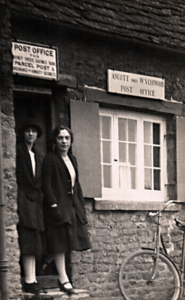
Ascott under Wychwood – post office with two ladies standing at door – 1920s
Oral Histories from our Archive
In Shipton‑under‑Wychwood, Dees’ Stores is mentioned often. Cyril Lane, interviewed in January 1993, remembered it not just as a shop but as a family landmark: groceries downstairs, drapery and shoes upstairs, and a sense that everything one needed could be found within its walls. Nearby, the early Shipton Tillyards — later well-known as an international exporter — began as a modest local enterprise. Through Phyllis Smith’s recollections when interviewed in October 1992 we learn that its supply chain remained rooted in the village, for example with hardware from Mr Willis.
Daily life was shaped by practical routines. Martha Oakley, interviewed in February 2003, recalled cutting bacon in the grocery store where she worked, we believe at the Bank House in Shipton. Her memories of shared hardship — and of homes without indoor plumbing well into the 1950s — remind us how central these shops were to community comfort.
Joan Townsend’s childhood Sundays were spent delivering milk and cream from her grandfather’s farm, part of an extended network of local provision. Milk delivery became a more ambitious enterprise in 1953 when Norman and Dorothy Treweeke (interviewed in May 1992) began their rounds. What started with 11 gallons collected from Finstock and carried by bicycle, soon grew into a fleet of vans delivering over 100 gallons a day across Shipton and Lyneham.
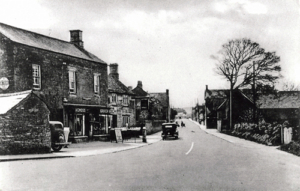
High Street Milton showing Post Office under the name of Moss the Grocer probably 1930s
Milton‑under‑Wychwood had its own constellation of shops and characters. Cissie Carpenter (in March 1993) remembered childhood games threaded through the village’s businesses, while Peter Davis traced the story of London House, the drapery shop his mother managed and his father later bought. For Charles Norman Wilks (May 1992) , early poverty meant hard work from a young age, including milk deliveries around Milton before he moved into construction and tree felling. And from Blanche Olive May Wright (1996) come vivid glimpses of early‑1900s shopping trips, wartime trade, and Christmas traditions that brought the village together.
Dorothy ‘Dor’ Thomson (Speaking in 2004)
Here is a sample audio with Dorothy ‘Dor’ Thomson. Like many others, she remembered Hathaways, when it was run by Captain Hathaway, a First World War officer who insisted on being addressed — very precisely — as Captain Hathaway. His shop was excellent, well stocked and well used, but children learned early to mind their manners.
She also recalled that, at the Post Office, Miss Coombes was known as ‘the dragon’, terrifying children with her stern manner. “We were really quite frightened to go in,” Dorothy recalled, though she admits Miss Coombes was harmless enough. The village was astonished when this formidable figure suddenly married Mr Wiggins and became Mrs Wiggins — a change the children struggled to remember.
Hear the Audio here >>> [Opens in new tab]
Dulcie Arundell and Shipton Shops
Based on the 1993 interview transcript, here is a summary of Dulcie Arundell’s memories of the shops and merchants in Shipton, which primarily cover her childhood and youth in the 1920s and 1930s.
Village Shops and General Stores
- Dulcie remembers how Mrs Avery at Avery’s store sold general groceries, Woodbine cigarettes, and ha’penny sweets, which she uniquely wrapped in two-pointed, hand-rolled blue paper bags.
- She mentions Harolds Dee at Dee’s store, and Franklin’s owned by the Franklin family, which she recalls as divided into hardware on the right and groceries on the left. It featured a small bank cubicle at the back and hosted a Christmas Bazaar which she rembers fondly.
- Of course she recalls Mrs Wiggins at the Post Office, which sold stationery, newspapers, and local postcards photographed by Packer of Chipping Norton. Mr. Wiggins also repaired clocks and watches. Dulcie recalls how the shop stayed open until 7:30 pm to send mail out on the late train.
- She also recalls Snowdrop House at the top end of the village, run by the Tubb Sisters . This she recalls as very small shop catering to ‘top enders’. They sold essentials like Sunlight Soap, soda, butter, sweets, and cigarettes
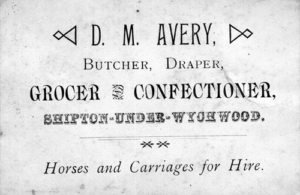
Avery business card Shipton
Specialty Vendors and Deliveries
- The “Shop on Wheels”: Mr. Goodban and Mr. Hawkes ran a mobile contraption parked in Rainbow’s orchard. They famously sold tinned herrings in tomato sauce, a favorite post-match meal for Dulcie’s uncles who played local football.
- Fresh Food Deliveries: Arthur “Fishy” Rainbow used a horse and wagon to deliver fresh fruit and fish, which likely arrived in the village via the railway. Another man named Rainbow also sold a few groceries and fruit from an end cottage on the Swinbrook Road.
- Livestock Feed: Mr. Stevens, a farmer from Taynton, delivered pig feed—referred to as “shocks and toppings”—directly to the cottages that kept livestock.
- Local Butchers: Mr. Foster originally operated a butcher’s shop at Salisbury Place, where Dulcie’s father worked as a roundsman before the business relocated to Charlbury. Later, Dick Avery ran a butcher shop on the same premises as The Lamb inn, which was managed by his wife.
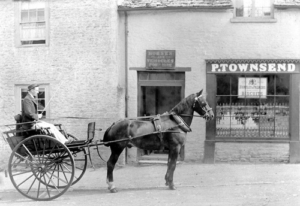
Horse and trap in front of Townsend stores, the precursor to Averys General Stores in Shipton. Believed to be Mr Townsend on the trap
Dulcie Arundell’s full recording (with transcript) is available here >>> [Opens in new tab]
These oral histories are a reminder of how the Wychwoods once shopped, worked, and looked after one another. In addition to our oral histories, here we also revisit some other records of Wychwoods shops and personalities.
Mrs Wiggins and Her Retirement
Mrs Kate ‘Kitty’ Wiggins, took over the running of the post office from her mother in 1930 and only retired in 1974. An article from a newspaper, currently not identified, features some of the background to her life and of the Post Office over time. 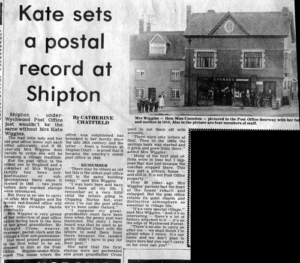
Here is a summary:
The article profiles Mrs Kate Wiggins, the long‑serving sub‑postmistress of Shipton‑under‑Wychwood Post Office, described as “the frail little lady” who is inseparable from the old red‑fronted building. The post office is notable for being the oldest in England still operating in its original building, having opened in 1845.
A member of Mrs Wiggins’ family has run the post office continuously since its founding. Her great‑grandfather, Richard Cross—a weaver, overseer, parish clerk, and the first sub‑postmaster—began the tradition. The house itself has belonged to the family since the late 16th century.
One quoted line from the article reads:
“There may be others as old but this is the oldest post office still in the same building today,” said Mrs Wiggins.
Mrs Wiggins treasures a collection of early postal relics, including the first letter ever addressed to the Shipton Post Office, sent by a footman at Shipton Court. She recalls stories of her great‑grandfather carrying letters up to Shipton Court because the landed gentry did not have to pay postage.
The article notes that early stamps were unperforated, and Cross used scissors to cut them apart. The post office originally handled only letters, but expanded in the 1860s with the introduction of the Post Office Savings Bank.
Unlike many early post offices that operated from inns, Shipton’s was always a private house. Over sixty years ago, Mrs Wiggins’ parents rebuilt and enlarged the front of the building, but its quiet charm remains.
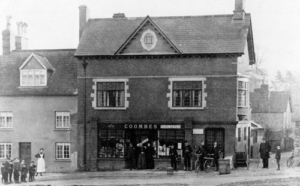
A photograph from 1910 shows Mrs Wiggins—then Miss Coombes—standing in the doorway with her father, mother, and four staff members.
Mrs Wiggins speaks warmly of Shipton as “a very special village” with deep history on the edge of Wychwood Forest. She acknowledges that when she retires, the family’s long custodianship will end:
“There’s no‑one to carry on after me… you can’t carry on for ever can you?”
More Memories of Mrs Wiggins
Former stalwart and founder member of the WLHS Dr. Margaret Ware records her thoughts on Mrs Wiggins in an artice published in The Wychwood magazine, June/July 2003 Vol 24 No 2. A PDF to read online or to download:
See PDF : Margaret Ware memories of Mrs Wiggins
A Walk Around Shipton -‘A Village of Shopkeepers’
Also featured in The Wychwood Magazine (of February 2023), here is a record of a walk around the village, revisiting old locations of shops in the village in PDF form to read online or download:
See PDF: Alan Vickers with Gordon Duester Shipton 2013
Even More Memories …..
Here is an extended article by Dorothy Brookes, taken from the WLHS Journal No. 10 (1995).